
Silent Auction Bid Sheet Template
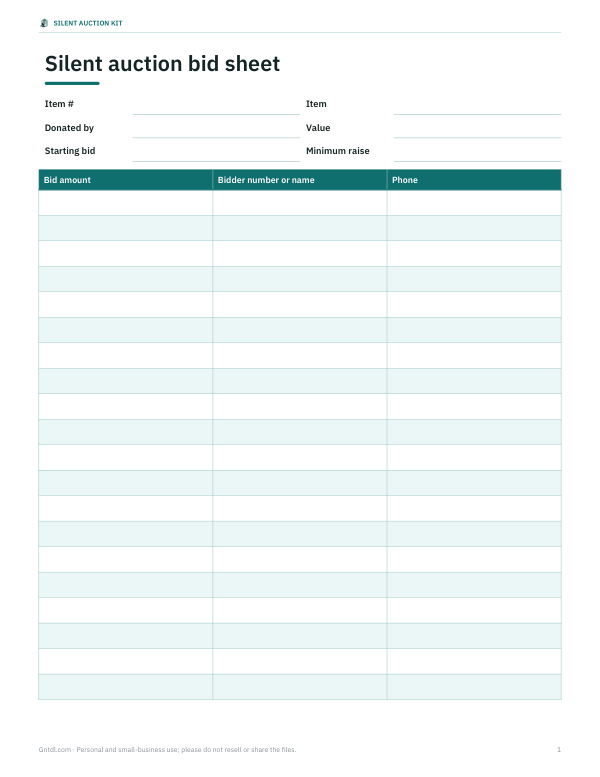
A silent auction runs on its bid sheets. Enter each item’s name, donor, description, fair market value, starting bid and minimum raise, and the generator creates a printable bid sheet for every item — with the minimum bid pre-filled on each line so bidders can’t underbid — plus a master list for the check-out table.
- Free to use
- No sign-up
- Runs in your browser
Bid sheet generator
Silent Auction Kit
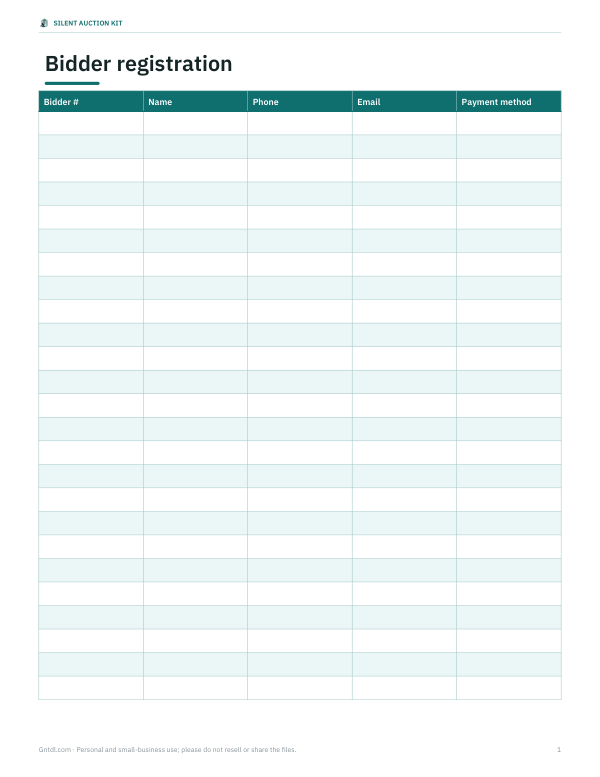
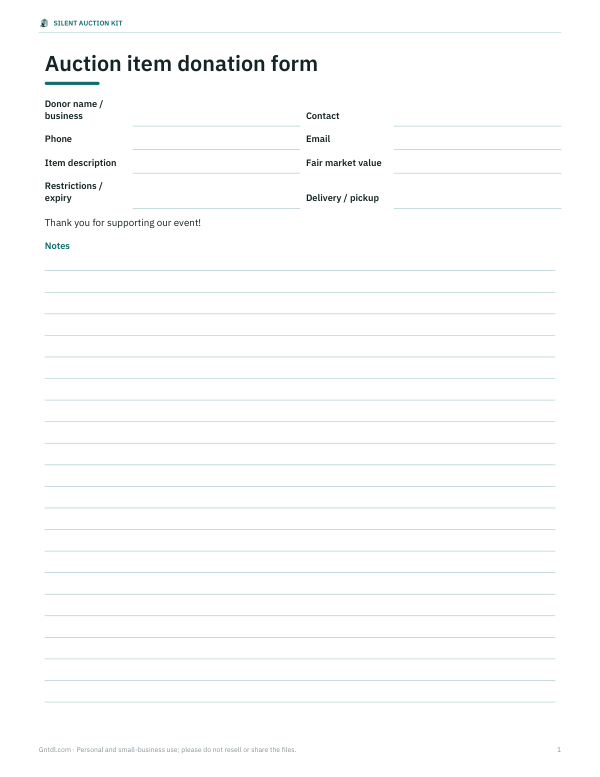
Printable bid sheet templates (with and without buy-it-now), bidder registration form, item donation form, auction item display cards, a master tracking workbook with totals and a donor thank-you letter.
- Blank bid sheet (PDF/DOCX)
- Registration (PDF/DOCX)
- Donation form (PDF/DOCX)
- Display cards (PDF)
- Master tracker (XLSX)
- Thank-you letter (DOCX)
Formats: PDF, DOCX, XLSX. Instant download after payment (link valid 72 hours, up to 5 downloads). AI-assisted: the templates were drafted with AI help and reviewed and laid out before publishing.
$5.00 USD, one-time 6 files · about $0.83 each
- Instant download
- 7-day refund
- Secure checkout by Stripe
7-day money-back guarantee. Full refund within 7 days of purchase, even after you download.
Free sample: Auction Master Tracker (PDF, 53 KB)
Full refund within 7 days — see the refund policy and license.
Free printables
Single sheets you can print right now, no sign-up. The full pack adds every sheet in one download plus the editable files.
 Printable Display Cards PDF
 Silent Auction Master Tracker
 Thank You Letter Template
What a silent auction bid sheet includes
| Section | Why it matters |
|---|---|
| Item number and name | Matches the item display and the check-out list |
| Description | Exactly what is included, dates, restrictions, expiry |
| Donor | Thanks the donor and adds credibility |
| Fair market value | Helps bidders judge value (and matters for tax receipts in some places) |
| Starting bid | Usually 30–50% of value to encourage early bids |
| Minimum raise | Keeps bidding moving in sensible steps |
| Bid lines | Each line pre-filled with the next minimum bid |
| Buy-it-now (optional) | Lets someone secure the item immediately at a premium |
Setting starting bids and increments
A starting bid of about 30–50% of the item’s value gets bidding going without giving items away. Minimum raises that scale with value keep momentum: $5 for items under $50, $10 up to $200, $25 up to $500 and $50–100 above that are common choices. Pre-filling each bid line with the next minimum amount avoids arguments and makes it easy to see the current high bid. A buy-it-now price of about 125–150% of value can capture keen bidders early.
Running the auction
- Number every item and display it with its bid sheet and a pen.
- Give bidders numbers at registration so sheets show numbers rather than full names and phone numbers.
- Announce closing times for each section 10 and 2 minutes before closing.
- At closing, draw a line under the last bid and collect sheets.
- Record winners on the master list and move to check-out.
- Keep the sheets as your record of results.
Worked example
A school auction has four items. The weekend cabin (value $450) uses a custom $200 start with $25 raises, so its sheet lists $200, $225, $250… The pizza night (value $80) gets the default 40% start of $30 with $10 raises; the signed football starts at $50 with $10 raises; the art class bundle starts at $60. The summary shows $810 of total value and $340 raised if every item sells at its opening bid, before any competitive bidding.
Item display tips
- Group items by theme or price range so bidders can browse easily.
- Use photos, certificates or a sample of the item.
- Create bundles — dinner plus movie tickets — to raise the value of small donations.
- Make descriptions specific: dates, expiry, number of people, restrictions.
- Put popular items in visible spots to draw crowds.
After the auction
Thank donors promptly with the final amount their item raised, and give winners receipts. In some countries, donors and winners may have tax considerations — for example, the portion of a winning bid above fair market value may be treated as a donation. Check local rules or ask an accountant; the templates record fair market value to help.
Planning timeline
| When | Task |
|---|---|
| 8–12 weeks before | Set a fundraising goal, form a small team, start asking for donations |
| 4–6 weeks before | Chase donation forms, photograph items, plan bundles |
| 2 weeks before | Set starting bids and increments, generate bid sheets and display cards |
| 1 week before | Print sheets, prepare bidder numbers, check payment methods |
| On the day | Set up tables by section, place sheets and pens, brief volunteers |
| Within a week after | Send thank-you letters to donors and share the total raised |
Volunteer roles on the night
- Registration — hands out bidder numbers and explains how bidding works.
- Table monitors — keep pens at each sheet, answer questions and watch for illegible bids.
- Closer — announces section closing times and collects sheets.
- Check-out — records winners on the master list, takes payment and hands over items or certificates.
Handling common problems
If a bid is unreadable, contact the previous bidder as well so the item still sells. If two people claim the last line at closing, the sheet collector’s marked line decides — explain this rule at the start. When an item gets no bids, offer it at the starting price during check-out or roll it into a bundle for a future event. Keep a spare set of blank bid sheets in case one gets spilt on.
Online and hybrid auctions
Many events now combine printed bid sheets with an online bidding page. If you run both, set one closing time and agree how online and paper bids are combined — for example, by adding the current online high bid to the sheet at intervals. Paper sheets remain popular because they are simple, social and don’t need phones or Wi-Fi.
Privacy
Everything is generated in your browser; item lists are not uploaded or stored.
Frequently asked questions
What should a silent auction starting bid be?
Often 30–50% of the item’s fair market value.
What is a good bid increment?
Scale it to value: around $5–10 for small items, $25–100 for larger ones.
Should bidders write their names?
Using bidder numbers protects privacy and speeds up check-out.
What is a buy-it-now price?
A price at which a bidder can win the item immediately, often 125–150% of value.
How many bid lines per sheet?
About 12–20 lines is usual for most items.
Can I print all sheets at once?
Yes, each item prints on its own page.
Should the fair market value be shown?
Usually yes; it helps bidders judge the item and records value for receipts.
Can I change the bid increment for one item?
Yes, add it as the sixth value on that item’s line.
Is anything stored?
No, it runs in your browser.